5 Steps How to Clean Heavy Road Film and Save Time (Easy Guide for Fleet Owners)
The accumulation of road film on commercial fleet vehicles represents a significant challenge for logistics managers and facility operators. Road film is not merely a layer of topical dust; it is a complex, electrostatically bonded matrix of carbon particulates, exhaust emissions, oxidized oils, and microscopic rubber fragments. These components adhere to the vehicle substrate through a combination of Van der Waals forces and ionic attraction, making standard water-based cleaning methods largely ineffective.
To maintain the professional appearance and structural integrity of a fleet, a systematic chemical approach is required. By utilizing professional-grade formulations from Pro Chemical Products, fleet owners can implement a high-efficiency cleaning protocol that reduces labor hours while achieving superior results. The following five-step methodology details the technical requirements for the professional removal of heavy road film.
Step 1: Preliminary Site Preparation and Mechanical Pre-Rinse
The efficacy of any chemical cleaning process is contingent upon the initial preparation of the vehicle and the environment. It is essential that the washing procedure is conducted in a controlled setting, preferably out of direct sunlight, to prevent the premature evaporation of chemical solutions. High surface temperatures can lead to chemical "flashing," which results in streaking and potential damage to the paint or clear coat.
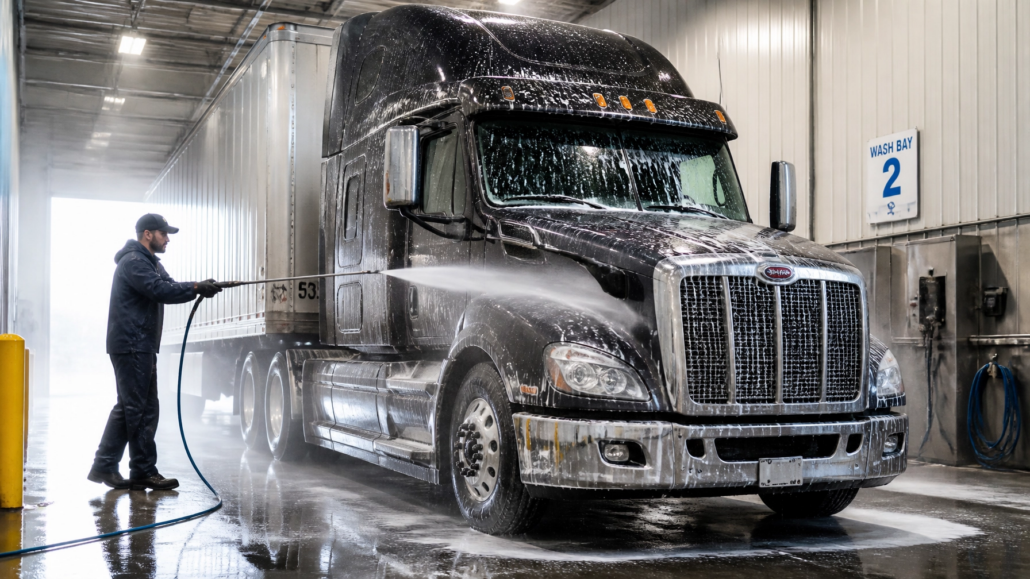
A high-pressure mechanical pre-rinse is utilized to remove loose debris, such as mud, grit, and bulk salt deposits. This step is critical as it prevents the introduction of mechanical abrasions during subsequent stages. High-pressure water, typically delivered at 2,000 to 3,000 PSI, should be directed from the top of the vehicle downward. Special attention is directed toward the undercarriage and wheel wells, where the highest concentrations of particulate matter are localized. By clearing the surface of loose contaminants, the chemical agents applied in later steps can directly interact with the bonded road film rather than being absorbed by topical dirt.
Step 2: Localized Application of Alkaline Degreasers
Once the loose debris has been eliminated, the focus shifts to the "film band": the lower third of the vehicle and the rear doors: where the concentration of greasy road film is highest. For these areas, a concentrated alkaline degreaser, such as CA Orange, is required.

CA Orange is a non-butyl, super-strength degreaser designed to emulsify petroleum-based soils and carbonaceous film. The application should follow a bottom-up trajectory to ensure uniform coverage and to prevent the formation of vertical "run-lines" that can occur if chemicals are allowed to stream down dry surfaces. A dwell time of three to five minutes is generally recommended; however, the surface must remain moist throughout this duration. During this phase, the alkaline surfactants penetrate the oily binder of the road film, facilitating its detachment from the substrate. This targeted approach is a key component of heavy-duty degreasing secrets utilized by industry professionals.
Step 3: Implementation of the Two-Step Chemical Neutralization System
The most effective method for removing road film without manual agitation is the two-step wash system. This process leverages the principles of pH neutralization to disrupt the electrostatic bond between the film and the vehicle surface.
- Low-pH Acidic Pre-Soak: An acidic solution is applied to the vehicle. This step targets the inorganic minerals and neutralizes the negative charges within the road film. It is particularly effective for cleaning aluminum components and brightening painted surfaces.
- High-pH Alkaline Detergent: Immediately following the acidic soak (and without a secondary rinse), a high-pH alkaline detergent is applied over the acidic layer.

The resulting exothermic reaction and pH shift create a chemical "lifting" action. The road film is physically separated from the paint, suspended in the foam, and prepared for removal. This technique is extensively covered in the ultimate guide to professional fleet washing, which emphasizes the importance of chemical synergy over physical scrubbing. The use of specialized equipment, such as dual-line injectors, ensures that the correct dilution ratios are maintained for maximum efficiency.
Step 4: High-Pressure Rinsing and Surface Agitation
Following the dwell period of the two-step system, the vehicle is subjected to a high-pressure rinse. Unlike the pre-rinse, this stage must be executed with precision. The operator should maintain a consistent distance between the nozzle and the surface, typically 12 to 18 inches, to utilize the kinetic energy of the water effectively.
The rinsing process is initiated from the bottom of the vehicle and proceeds upward. This ensures that the chemicals are rinsed away while still active, preventing the redeposition of suspended solids onto lower panels. Once the entire surface has been treated, a final top-down rinse is performed to flush all residual chemicals and foam into the drainage system. For fleets with extreme road film accumulation, soft-bristled brushes may be utilized in a "controlled contact" manner on vertical surfaces to assist in the removal of any remaining stubborn particulates. However, with the appropriate chemical concentrations from Pro Chemical Products, the need for manual agitation is significantly minimized.
Step 5: Post-Wash Finishing and Component Protection
The final stage of the cleaning protocol involves the removal of water spots and the application of protective coatings. Drying is facilitated by compressed air or high-absorbency microfiber materials to ensure a streak-free finish. For fleet owners seeking to maintain the longevity of their assets, the application of a tire dressing is an essential finishing touch.

Pro Star Tire Dressing is utilized at this stage. As a solvent-based premium dressing, it provides a fast-drying, high-gloss finish that is resistant to water wash-off. The application of Pro Star not only enhances the aesthetic appeal of the vehicle but also provides a barrier against ozone degradation and UV radiation, which are primary causes of tire sidewall cracking. Understanding the distinction between solvent-based and water-based tire dressings assists managers in selecting the appropriate level of durability for their specific operating environment.
Conclusion: Maximizing Operational Efficiency
The implementation of a structured 5-step cleaning protocol allows fleet owners to achieve a superior level of cleanliness while optimizing labor and chemical costs. By transitioning from manual scrubbing to a chemically-driven process, the time required per vehicle is reduced by approximately 30-50%.
Pro Chemical Products, a family-owned business since 1971, provides the professional-grade formulations necessary to execute these steps effectively. From the high-alkaline power of CA Orange to the protective finish of Pro Star Tire Dressing, each product is engineered for industrial-strength performance. For further inquiries regarding custom chemical solutions or to explore the full range of pressure washing chemicals, contact a technical representative today.

Leave a Reply
Want to join the discussion?Feel free to contribute!