
Soft Wash Chemistry for Lasting Results: How Surfactant 141 Improves Exterior Cleaning

Soft washing is a chemistry-driven exterior cleaning process in which a cleaning solution is applied at relatively low pressure and allowed to remain on the surface before controlled rinsing. Unlike conventional high-pressure cleaning, the primary objective is not mechanical force. The result is determined by the compatibility of the cleaner, the condition of the substrate, the application method, and the time allowed for the solution to work.
Within a properly designed soft wash system, Surfactant 141 assists with several important performance factors, including cling, coverage, dwell time, and the release of organic buildup. When incorporated according to product directions, it can improve the application characteristics of sodium hypochlorite-based cleaning solutions used for residential and commercial pressure washing.
What Surfactant 141 Contributes to a Soft Wash System
Surfactants are surface-active compounds that modify the interaction between a liquid and a solid surface. By reducing surface tension, a surfactant can improve wetting and distribution across materials that may otherwise cause a water-based solution to bead, separate, or run off rapidly.
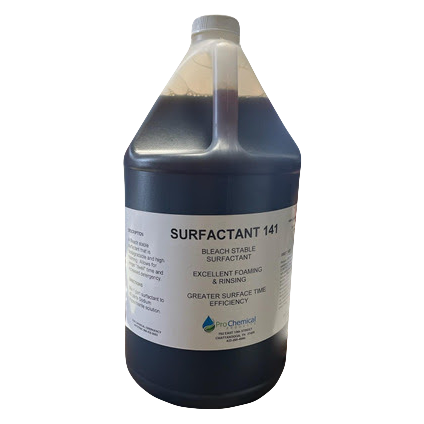
According to the Pro-Chemical Products pressure washing product page, Surfactant 141 is a bleach-stable surfactant that provides foaming and cleaning ability, assists sodium hypochlorite with remaining on the surface longer, and is formulated for efficient rinsing.
These characteristics are relevant to exterior cleaning because soft wash solutions frequently need to be applied to:
- Vertical siding and wall assemblies
- Pitched roofing materials
- Masonry, brick, and concrete
- Stucco and other textured claddings
- Commercial façades and loading-area walls
- Residential gutters, soffits, and exterior trim
- Fences, decks, and other outdoor structures
The surfactant does not replace the active cleaner. Instead, it modifies the physical behavior of the solution so that the selected cleaning chemistry can be distributed more uniformly and maintained in contact with the substrate for an appropriate period.
Cling: Maintaining Contact on Vertical and Sloped Surfaces
Rapid runoff is a common limitation when a low-viscosity solution is applied to a vertical or inclined surface. A watery mixture may descend before the active chemistry has adequately contacted the contamination. This can produce uneven treatment, visible missed areas, or the need for repeated applications.
Surfactant 141 produces foam and increases the solution’s ability to remain on the surface. Improved cling can provide the following operational advantages:
- Greater resistance to immediate gravity-driven runoff
- More consistent coverage on vertical walls and roof planes
- Improved visual identification of treated areas
- Reduced formation of untreated “holidays”
- More uniform exposure of organic deposits to the cleaning solution
Foam should not be interpreted as a complete indicator of cleaning performance. A surface may require additional evaluation, reapplication, agitation, or rinsing depending on the contamination and substrate. However, visible foam can provide useful application feedback when a technician is working across a large residential or commercial property.

Coverage and Wetting Across Exterior Materials
Exterior soils are not uniform. Algae, mildew, mold-related staining, biofilm, atmospheric particulate matter, and embedded dirt can occupy surface irregularities and microscopic voids. Hydrophobic or weathered materials may also resist even distribution of plain water-based solutions.
By reducing surface tension, Surfactant 141 assists the solution in spreading across the substrate rather than remaining in isolated droplets. Improved wetting can support more consistent contact with:
- Textured siding
- Shingles and roofing surfaces
- Stucco and EIFS
- Concrete block and masonry
- Painted or coated exterior materials
- Wood and composite outdoor structures
The practical objective is not unrestricted penetration into the building assembly. The solution should remain on the intended exterior surface and should not be allowed to enter wall cavities, electrical components, ventilation openings, or other areas not designed for liquid exposure.
When organic buildup is present, the sodium hypochlorite component is generally responsible for oxidation and breakdown of susceptible organic staining and growth. Surfactant 141 assists by promoting more complete surface wetting and contact. The final result remains dependent on the cleaner concentration, water quality, weather, contamination severity, application technique, and substrate compatibility.
Dwell Time and Controlled Chemical Action
Dwell time is the interval during which a cleaning solution remains wet and active on the surface before rinsing. Adequate dwell time is important in soft washing because the process is intended to rely on controlled chemistry rather than excessive pressure.
Surfactant 141 can assist with dwell time by producing a clinging foam that slows rapid runoff. This may be particularly valuable during:
- Warm or sunny conditions
- Cleaning of large wall sections
- Treatment of steep or difficult-to-access surfaces
- Removal of established organic films
- Commercial maintenance work requiring consistent application across multiple elevations
Dwell time should never be treated as a fixed universal value. The product label, site conditions, surface response, and contamination level should govern the process. If a solution begins to dry, it should be managed in accordance with the applicable label directions and professional cleaning procedures. A wet surface does not automatically indicate that a longer dwell period is appropriate.
Testing should be conducted before broad application. A small, inconspicuous area can be evaluated for color change, coating response, runoff behavior, and cleaning effectiveness. The surface should then be rinsed thoroughly and inspected before the complete project proceeds.
Application and Mix Considerations
Surfactant 141 should be incorporated into a soft wash system only in accordance with its current label and technical documentation. Exact ratios should not be generalized across all equipment, water sources, sodium hypochlorite strengths, or applications.
Factors requiring consideration include:
- Final solution composition: The concentration of sodium hypochlorite and other cleaners affects both performance and surface risk.
- Proportioning equipment: Downstream injectors, batch systems, and proportioning pumps may deliver different concentrations and foam characteristics.
- Water quality: Hardness, temperature, and impurities can influence wetting, foaming, and rinsing.
- Surface type: Vinyl, painted metal, masonry, wood, roofing, glass, and delicate coatings have different chemical tolerances.
- Weather conditions: Heat, wind, direct sunlight, and low humidity can accelerate drying.
- Rinsing requirements: A formulation that clings effectively must still be removed completely from the surface and adjacent areas.
- Storage and compatibility: Chemical containers, pumps, hoses, and seals must be compatible with the selected solution.
Before mixing, the current product label and SDS should be reviewed. Mixing procedures should be followed exactly, and incompatible chemicals should not be combined. In particular, sodium hypochlorite should not be mixed with acids, ammonia-containing products, or other materials that may generate hazardous gases or uncontrolled reactions.
Surface Safety and Environmental Controls
Soft washing is lower pressure than many conventional pressure washing methods, but it is not risk-free. Chemical exposure, runoff, overspray, and substrate damage remain possible if the process is not controlled.
Professional procedures should include:
- Pre-wetting and protecting vegetation when appropriate
- Covering or relocating sensitive outdoor items
- Avoiding direct spray into electrical fixtures, openings, and ventilation systems
- Controlling runoff so cleaning solution does not enter prohibited drainage areas
- Testing painted, oxidized, aged, or previously repaired surfaces
- Maintaining appropriate separation from occupants, pedestrians, and vehicles
- Rinsing windows, trim, equipment, and adjacent surfaces as required
- Inspecting the finished surface for residue, streaking, and incomplete cleaning
Personal protective equipment should be selected according to the product label and SDS. Depending on the task, this may include chemical-resistant gloves, protective eyewear or a face shield, suitable protective clothing, slip-resistant footwear, and respiratory protection when required by the hazard assessment. PPE does not replace ventilation, application controls, training, or label compliance.
Residential and Commercial Applications
For residential properties, Surfactant 141 may be considered for soft wash systems treating siding, roofs, gutters, fences, and other exterior surfaces where improved cling and distribution are needed. The selected cleaner must remain appropriate for the material, and special attention should be given to landscaping, windows, outdoor furniture, and painted finishes.
For commercial properties, the same chemistry principles apply to façades, retail buildings, offices, warehouses, service facilities, and other structures. Commercial cleaning programs may benefit from consistent application patterns, visible coverage, controlled dwell time, and efficient rinsing across larger surfaces. A site-specific plan should be established when multiple substrates or sensitive building components are present.
Pro-Chemical Products provides a range of pressure washing chemicals, commercial-strength sodium hypochlorite, specialty cleaners, and related products for professional exterior cleaning. The company has manufactured cleaning products since 1971 and also supports custom formulation inquiries for industry-specific requirements.
Why Product Selection Matters
A reliable soft wash result is produced by more than foam volume. The formulation must be compatible with the selected cleaner, application equipment, target substrate, and required rinsing process. Surfactant 141 is designed to assist with the physical delivery of a bleach-based solution, while the complete cleaning outcome is determined by the system as a whole.
When properly selected and applied, the product can assist with:
- Improved cling on vertical and sloped surfaces
- More uniform surface wetting
- Better visual coverage during application
- Extended contact time before rinsing
- More efficient exposure of organic buildup to the active cleaner
- Controlled rinsing after the dwell period
These benefits should be evaluated through testing and observation rather than assumed in every application.

A Technical Approach to Lasting Exterior Cleaning
Lasting results in residential and commercial soft washing depend on complete, controlled cleaning rather than aggressive pressure alone. Surfactant 141 assists the process by improving how a sodium hypochlorite-based solution behaves on the surface. Better cling, coverage, and dwell time can contribute to more consistent removal of organic buildup when the solution is correctly selected, safely applied, and thoroughly rinsed.
Pro-Chemical Products remains a practical source for professional-grade cleaners, sodium hypochlorite, soft wash additives, and pressure washing chemicals. Product information, application requirements, and safety documentation should be reviewed before use. For product questions or specialized chemical requirements, Pro-Chemical Products can be contacted directly.


Leave a Reply
Want to join the discussion?Feel free to contribute!