
Shop Floors, Parts, and Equipment: How CA Orange Handles Every Industrial Degreasing Job
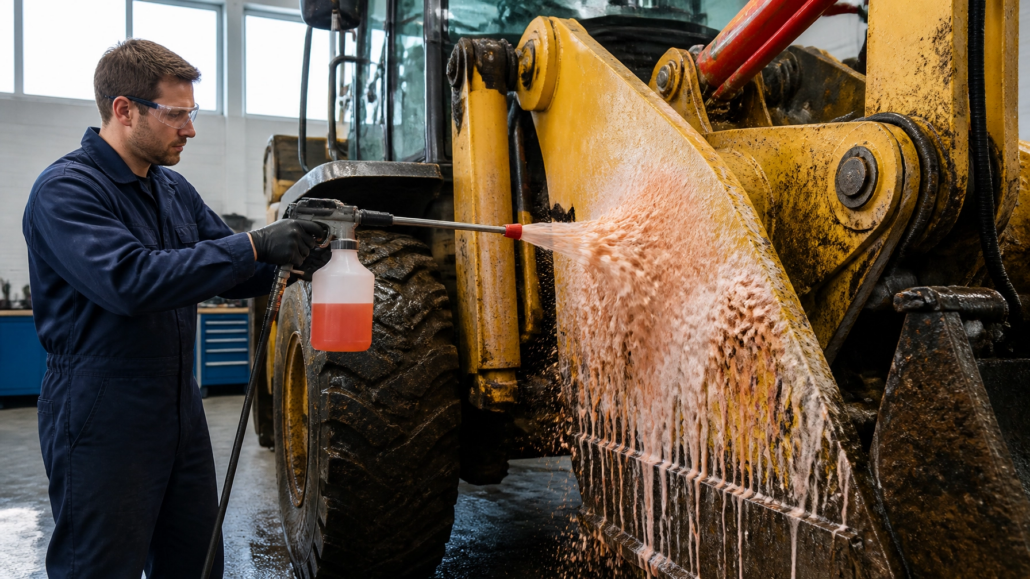
Industrial grease is rarely confined to one surface. Petroleum-based oils, hydraulic fluid, lubricants, carbon deposits, and road-derived contaminants can accumulate on concrete floors, machine housings, removable components, and heavy equipment. Each substrate requires an appropriate application method, but the cleaning chemistry must remain sufficiently powerful to penetrate and emulsify the soil.
CA Orange from Pro Chemical Products is an alkaline, non-butyl, super-strength industrial degreaser concentrate formulated for demanding maintenance environments. Its concentrated format allows the solution strength to be adjusted according to soil load, surface type, and cleaning equipment. As a result, the same product can be incorporated into procedures for shop floors, parts washing, machinery maintenance, and heavy equipment cleaning.
Why Industrial Degreasers Outperform Household Cleaners
Household cleaners are generally formulated for light oils, dust, food residue, and routine surface soils. Their active ingredients and concentration levels are not normally intended to penetrate thick petroleum deposits or dissolve the layered contamination found in industrial settings.
Industrial degreasers are formulated for more demanding conditions through a combination of:
- Higher alkalinity for breaking down persistent organic soils.
- Surfactants that improve wetting and penetration.
- Emulsifying agents that suspend loosened oil in the wash solution.
- Concentrated chemistry that permits controlled dilution.
- Greater compatibility with pressure washers, floor scrubbers, parts-washing stations, and commercial spray systems.
This distinction is important because industrial grease is frequently bonded to a surface by heat, pressure, oxidation, or repeated contamination. Wiping with a weak cleaner may remove the visible film while leaving behind an embedded residue. The remaining film can attract additional dust, interfere with inspections, and create slippery conditions.
CA Orange is listed by Pro Chemical Products as a high-alkaline detergent and cleaner/degreaser concentrate for heavy equipment, industrial plants, and floor scrubbers. The complete cleaners and degreasers catalog also identifies the product as a non-butyl industrial formulation.
How CA Orange Emulsifies and Lifts Petroleum-Based Grime
Petroleum-based grime is hydrophobic, meaning it does not readily combine with water. Water alone therefore has limited ability to remove motor oil, grease, hydraulic residue, and similar contaminants.
CA Orange addresses this problem through alkaline cleaning chemistry and surfactant action:
-
The solution wets the contaminated surface.
Surfactants reduce surface tension, allowing the diluted degreaser to spread across concrete, painted equipment, and metal components rather than forming isolated droplets. -
The alkaline solution penetrates the soil layer.
The high-alkaline formulation assists in loosening organic deposits and disrupting the bonds between accumulated grime and the substrate. -
Grease is dispersed into the solution.
Emulsification breaks large oil deposits into smaller droplets that can remain suspended in the cleaning solution rather than immediately redepositing on the surface. -
Agitation separates the remaining contamination.
Brushing, scrubbing, or pressure rinsing supplies the mechanical energy required to release softened deposits from pores, seams, tread marks, and textured metal. -
Rinsing removes the emulsified soil.
The contaminated solution must be flushed from the surface with clean water. Chemical action is not complete until the loosened grease and residual alkalinity have been removed.
This process is particularly valuable where thick deposits cannot be removed efficiently through wiping alone.
Application 1: Shop Floors and Maintenance Bays
Concrete shop floors commonly retain oil because of their porous structure. Epoxy-coated floors may be less absorbent, but grease can still accumulate along expansion joints, beneath vehicles, around lifts, and near machinery.
For floor and maintenance-bay cleaning, the following procedure is appropriate:
- Remove loose debris before applying the degreaser.
- Dilute CA Orange according to the soil load and the manufacturer’s instructions.
- Apply the solution evenly with a pump sprayer, mop, automatic scrubber, or compatible pressure-washing system.
- Allow approximately three to five minutes of dwell time where heavy deposits are present.
- Prevent the solution from drying on the floor.
- Agitate with a stiff brush, rotary floor machine, or scrubber pad.
- Recover or collect the contaminated wash water where required.
- Rinse thoroughly with clean water.
- Inspect the floor after drying to confirm that no oily film or alkaline residue remains.
Published CA Orange guidance identifies medium-duty dilution ranges of approximately 1:20 to 1:50 for industrial floors and warehouse maintenance. Heavier deposits may require a stronger mixture. Dilution ratios should be treated as starting points rather than universal formulas because concrete porosity, temperature, contamination age, and mechanical agitation all influence performance.
A clean rinse is essential in maintenance bays. If emulsified oil is left behind, the surface can remain slippery or develop a dull residue. Wastewater should be managed in accordance with facility procedures, local discharge requirements, and the capabilities of the site’s oil-water separator or wastewater system.

Application 2: Machinery, Engines, and Heavy Equipment
Heavy equipment presents multiple cleaning challenges. Grease may be concentrated around pivot points, hydraulic fittings, undercarriages, engine compartments, wheel hubs, and protective guards. Vertical surfaces can also cause a diluted degreaser to run off before sufficient dwell time has occurred.
A practical equipment-cleaning sequence includes:
- Park and secure the equipment on an appropriate wash surface.
- Allow hot components to cool to a safe temperature.
- Remove loose soil with compressed air or low-pressure water where appropriate.
- Protect electrical connectors, open bearings, air intakes, control panels, and sensitive sensors.
- Apply the correctly diluted CA Orange from the lower section upward to promote even coverage and reduce streaking.
- Allow sufficient dwell time without permitting the product to dry.
- Agitate concentrated deposits with a suitable brush.
- Rinse from the upper section downward with controlled water pressure.
- Inspect seams, undersides, and recessed areas for remaining grease.
- Dry or drain the equipment as required before returning it to service.
For engines, machinery, and heavy equipment, published Pro Chemical Products guidance identifies approximate heavy-duty dilution ranges of 1:5 to 1:10. A stronger solution may be appropriate for baked-on contamination, while a weaker mixture may be adequate for routine maintenance. The precise ratio should be established through a controlled test area.
Aluminum, zinc, painted finishes, rubber components, and specialized coatings require additional caution. A spot test should be performed before broad application, particularly when a stronger concentration or extended dwell time is being considered.
Application 3: Parts Washing and Removable Components
Small parts can often be cleaned more effectively through controlled soaking than through direct pressure spraying. Brackets, hardware, machine guards, tools, and removable fittings may contain grease in threads, recesses, and channels that are difficult to reach with a cloth.
For parts-washing applications:
- Place the components in a compatible tray or parts-washing container.
- Prepare the diluted solution based on the amount and age of contamination.
- Submerge only components that are compatible with the alkaline chemistry.
- Allow the parts to soak for several minutes, monitoring the process rather than relying on an unattended extended soak.
- Agitate with a brush to reach seams, threads, and recessed areas.
- Rinse each component with clean water.
- Dry metal parts promptly to reduce flash rust and water retention.
- Lubricate components again where the original lubricant has been removed.
Heavy grease may require a stronger solution, additional dwell time, or repeated agitation. Increasing concentration is not always the most efficient response. Mechanical action and solution temperature can also influence cleaning speed, provided that the product label and equipment specifications permit their use.

Dilution and Application Best Practices
The concentrated format of CA Orange is a significant operational advantage for facilities with varied cleaning requirements. A single product inventory can be adapted for heavy, medium, and light maintenance work rather than requiring a separate ready-to-use cleaner for every task.
A practical starting framework is:
- Heavy soil: Approximately 1:5 to 1:10 for engines, machinery, and heavily contaminated equipment.
- Medium soil: Approximately 1:20 to 1:50 for shop floors, warehouse areas, and routine equipment cleaning.
- Light maintenance: More dilute solutions, potentially 1:100 or greater, when only a light film or general soil is present.
These ratios should not replace the product label, technical guidance, or an SDS review. Measurement should be performed with calibrated vessels or a controlled dispensing system. Manual estimation can produce excessive chemical consumption, inadequate cleaning strength, or unnecessary surface exposure.
Application conditions should also be evaluated. Hot surfaces may cause premature drying, while very cold grease may require additional dwell time or agitation. Direct sunlight, airflow, substrate porosity, and water pressure can all affect the working time of the solution.
Safety, Compatibility, and Rinse Requirements
CA Orange is an alkaline industrial chemical and should be handled as a concentrated product. Personnel should review the applicable Safety Data Sheet and utilize chemical-resistant gloves, eye protection, protective clothing, and adequate ventilation.
The following controls should be maintained:
- Never mix the degreaser with acids, bleach, or other cleaning chemicals.
- Do not apply to sensitive surfaces without a compatibility test.
- Avoid prolonged contact with skin, eyes, and unprotected materials.
- Keep containers clearly identified and securely closed.
- Prevent overspray from reaching occupied areas, drains, vehicles, or incompatible surfaces.
- Contain and manage contaminated runoff according to site and local requirements.
- Rinse equipment and surfaces thoroughly after cleaning.
Rinsing is not an optional finishing step. It removes emulsified petroleum soil, detached solids, and residual alkaline solution. Inadequate rinsing can produce streaking, residue, surface dulling, or the redeposition of grease.

Why Facilities Select Pro Chemical Products
Pro Chemical Products has served retail and wholesale customers from Chattanooga, Tennessee, since 1971. Its product range is designed for commercial cleaning, industrial maintenance, fleet washing, and related professional applications.
CA Orange provides several practical advantages:
- Commercial-strength alkaline cleaning performance.
- Non-butyl formulation.
- Concentrated dilution flexibility.
- Applications across floors, parts, machinery, and heavy equipment.
- Compatibility with common commercial application methods when properly utilized.
- Cost control through adjustable solution strength.
- Availability from a trusted local Chattanooga manufacturer.
For facility managers, shop owners, and professional technicians, the value of a degreaser is determined by more than its initial cleaning power. Consistent dilution, predictable application, efficient rinsing, and broad utility are equally important. Pro Chemical Products provides CA Orange and related cleaners and degreasers for operations that require a practical solution across multiple maintenance areas.
For product guidance, purchasing information, or application questions, the Pro Chemical Products contact page provides the appropriate point of contact. A properly selected and correctly diluted degreaser can reduce manual scrubbing, improve maintenance-bay conditions, and support more consistent cleaning results across industrial operations.


Leave a Reply
Want to join the discussion?Feel free to contribute!