
Pro Star Tire Dressing: The Professional’s Guide to a Sling-Free, Showroom Finish
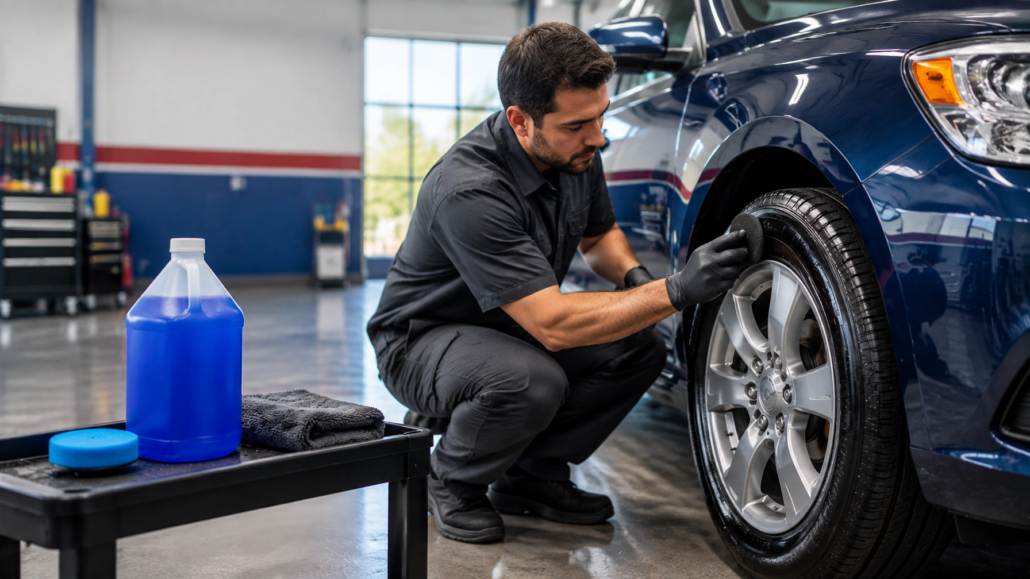
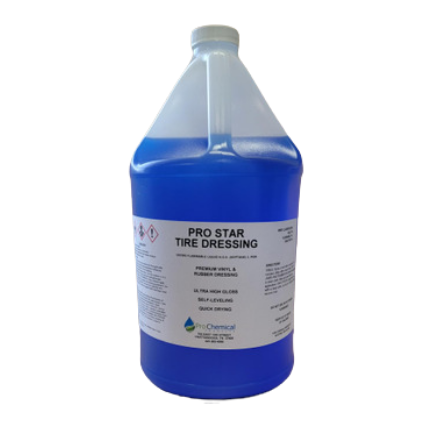
A vehicle’s tires are among the final surfaces evaluated during a professional detail. Even when the paint, glass, wheels, and interior have been thoroughly serviced, dull or uneven sidewalls can diminish the completed presentation. Pro Star Tire Dressing from Pro-Chemical Products is formulated for professional detailers, fleet maintenance teams, mobile technicians, and qualified DIY users seeking a fast-drying, water-resistant finish with reduced sling when correctly applied.
The solvent-based premium rubber and tire dressing is identified by Pro-Chemical Products as fast drying, high gloss, and water resistant. Its rapid evaporation profile assists in reducing the risk of product migration onto painted body panels, provided that the tire is properly prepared and excess material is removed.
What Pro Star Tire Dressing Does
Tire dressing is a finishing treatment applied after the sidewall has been cleaned, rinsed, and dried. It is not a substitute for tire cleaning, and it should not be regarded as a repair product for cracked, damaged, or deteriorated rubber.
Pro Star is designed to:
- Restore a deep black appearance to dull rubber.
- Produce a satin-to-high-gloss visual result depending on application quantity and finish preference.
- Dry rapidly to support efficient vehicle turnaround.
- Provide water resistance against rain and road spray.
- Reduce the likelihood of sling when applied in a thin, uniform film.
- Establish a surface film that assists in limiting direct exposure to road grime and environmental contaminants.
- Complement polished wheels, clean paint, and completed exterior detailing work.
The product’s solvent carrier evaporates, or “flashes,” after application. The remaining film produces the visible finish. This behavior distinguishes Pro Star from many basic consumer tire dressings that may remain wetter on the surface, require longer drying periods, or wash away more rapidly under repeated exposure.
Why Tire Preparation Determines the Result
A dressing cannot create a uniform finish when it is applied over road film, brake dust, mud, oxidized rubber, or old product residue. Inadequate preparation commonly produces streaking, patchy gloss, brown discoloration, and premature wash-off.
Tire sidewalls may contain:
- Petroleum-based road film.
- Brake dust and metallic particulate.
- Mud, salt, and mineral residue.
- Tire browning caused by surface oxidation and chemical migration.
- Residual detergent or degreaser.
- Previous silicone or solvent-based dressing.
- Industrial dust and environmental fallout.
A dedicated tire cleaner or compatible degreaser should be utilized before Pro Star is applied. The sidewall should be agitated with a suitable brush until runoff is substantially cleaner and the rubber presents a consistent, residue-free appearance. The tire should then be rinsed thoroughly.
For heavy contamination, a second cleaning cycle may be required. Products from the Pro-Chemical Products cleaners and degreasers category may be evaluated according to the soil type, rubber compatibility, and current product directions.
Satin-to-High-Gloss Finish Control
Pro Star is generally selected when a deep-black, high-impact finish is desired. However, the appearance can be moderated through application technique.
Satin or controlled finish
A lower-sheen appearance may be produced by:
- Applying a small quantity to a clean foam applicator.
- Spreading the dressing across the sidewall in a thin film.
- Avoiding saturation of raised lettering and recessed grooves.
- Allowing the product to flash before leveling the surface with a clean microfiber towel.
- Removing visible excess before the vehicle is released.
High-gloss finish
A more reflective finish may be produced by:
- Applying an initial thin, uniform layer.
- Allowing the first layer to stabilize.
- Inspecting the sidewall for dry or untreated areas.
- Applying a second light layer only when permitted by the current product instructions.
- Removing pooling or excess material with a clean microfiber towel.
Higher product volume does not automatically produce greater durability. Excess dressing can extend drying time and increase the possibility of sling. A controlled film generally produces a more professional result than a heavily saturated sidewall.
Comprehensive Pro Star Application Procedure
The following sequence can be incorporated into detailing-shop, fleet, mobile-detailing, and personal vehicle-maintenance workflows.
1. Inspect the tire
Before cleaning, inspect the tire for:
- Sidewall cracking.
- Bulges or deformities.
- Exposed cords.
- Punctures or embedded objects.
- Irregular wear.
- Damage requiring evaluation by a qualified tire professional.
Tire dressing should never be utilized to conceal a safety defect.
2. Clean the tire and wheel
Apply a suitable tire or wheel cleaner to a cool surface. Agitate the complete sidewall, including lettering, ribs, grooves, and the lower portion near the wheel lip. Heavy deposits may require repeated brushing.
The wheel should be cleaned separately to prevent contaminated runoff from redepositing onto the rubber.
3. Rinse completely
All cleaner, loosened soil, and old dressing should be removed with clean water. Residual alkaline or acidic chemistry can interfere with finish uniformity and may contribute to spotting or premature degradation of the new film.
4. Dry the sidewall
The sidewall must be dry before Pro Star is applied. Moisture trapped in lettering, grooves, or textured rubber can dilute the dressing and produce inconsistent gloss.
Forced air may be utilized around raised lettering, the bead area, and the wheel lip. Adjacent painted panels should also be checked for standing water that could transport uncured dressing.
5. Select the application method
A foam applicator pad is generally preferred because it provides controlled coverage and limits overspray. A small amount of Pro Star should be placed on the applicator and distributed evenly across the sidewall.
Spray application may be considered only when authorized by the current product instructions and when suitable ventilation, ignition-source control, and overspray containment are available. Direct spraying onto the tire can increase product waste and may transfer dressing to wheels, brake components, paint, flooring, or nearby personnel.
Pro Star should remain off:
- The tread.
- The contact patch.
- The tire shoulder where traction is required.
- Brake rotors and pads.
- Pedals, steering components, and other friction-sensitive surfaces.

6. Allow adequate curing time
Pro-Chemical Products guidance associated with Pro Star recommends allowing at least 15 minutes before the vehicle is driven. The precise curing period can vary according to temperature, humidity, airflow, product quantity, and surface condition.
The vehicle should remain stationary until no visibly wet areas remain. Cool, shaded surfaces generally provide a more predictable working environment than hot tires exposed to direct sunlight.
7. Level the finish
After the dressing has flashed, a clean microfiber towel should be utilized to remove excess material and level the sidewall. This step assists in reducing sling and produces more consistent gloss.
The final sidewall should be free of:
- Wet pools.
- Heavy streaks.
- Oily bands.
- Product buildup in lettering.
- Untreated sections.
- Visible transfer onto the wheel or fender.
Dilution and Product Control
No universal dilution ratio should be assumed for Pro Star. The product is described by Pro-Chemical Products as a ready-to-apply solvent-based tire dressing, and the current label or technical documentation should govern whether dilution is permitted for a specific application.
If a lower-gloss appearance is required, application quantity should generally be reduced before dilution is considered. Unapproved dilution can alter drying behavior, gloss, water resistance, surface adhesion, and sling performance.
For operations seeking repeatable results, product control should be documented through:
- Quantity applied per tire or vehicle.
- Applicator type.
- Number of coats.
- Flash or curing time.
- Ambient temperature and humidity.
- Vehicle release time.
- Rework caused by sling or uneven coverage.
- Appearance after the next scheduled wash.
This information allows a detailing shop or fleet operator to establish a consistent standard without applying unnecessary product.
UV, Road Grime, and Longevity
Tire sidewalls are exposed to ultraviolet radiation, ozone, heat, rain, road salt, brake dust, petroleum residue, and repeated wet-dry cycles. A dressing film can provide a supplementary barrier that reduces direct contact between the outer rubber surface and some environmental contaminants.
Pro Star’s documented water resistance assists in retaining the finished appearance through normal exposure to rain and road spray. The treated surface may also be easier to maintain because road grime and dust are less likely to bond immediately to a clean, conditioned sidewall.
Longevity is influenced by:
- Vehicle mileage.
- Frequency of washing.
- Road and weather conditions.
- Pressure-washing intensity.
- Surface preparation.
- Product quantity.
- Tire texture and rubber composition.
- Exposure to UV radiation, salt, and industrial contamination.
Compared with many consumer tire dressings, a professional solvent-based formulation such as Pro Star can provide a more durable and visually consistent result when the sidewall is correctly prepared and the product is allowed to cure. No fixed service interval should be promised. Reapplication should be based on inspection rather than an automatic schedule.

Practical Applications
Detailing shops
Professional shops can utilize Pro Star for:
- Exterior detailing packages.
- Used-vehicle reconditioning.
- Dealership inventory preparation.
- Showroom presentation.
- Paint-correction completion services.
- Customer-requested high-gloss finishes.
A standardized application quantity and curing period can reduce rework and improve consistency across technicians.
Mobile detailers
Mobile operators benefit from a product that dries rapidly and can be applied with minimal equipment. A foam applicator, clean microfiber towels, suitable ventilation, and ignition-source controls should be maintained as part of the mobile setup.
Fleet vehicles
Fleet maintenance teams can incorporate Pro Star into scheduled cleaning programs for:
- Delivery vans.
- Service trucks.
- Rental vehicles.
- Utility vehicles.
- Tractor-trailers.
- Municipal fleets.
- Dealership and commercial inventory.
Vehicles exposed to highway spray, construction zones, industrial yards, or winter road salt may require more frequent cleaning and inspection.
Everyday vehicle upkeep
Qualified DIY users can utilize Pro Star for routine vehicle maintenance when the product’s professional-use classification, flammability warning, and handling requirements can be followed. Consumer users should review the current product label and Safety Data Sheet before application.
Safety Requirements
Pro-Chemical Products identifies Pro Star Tire Dressing as extremely flammable and intended for professional detail use only. The following controls should be maintained:
- Keep the product away from flames, sparks, smoking, and hot surfaces.
- Provide adequate ventilation during application.
- Avoid atomizing the product in enclosed areas.
- Utilize suitable gloves and eye protection.
- Keep containers closed when not in use.
- Store the product in an appropriate location consistent with fire-safety requirements.
- Clean spills promptly and prevent uncontrolled runoff.
- Train personnel in flammable-liquid handling and emergency procedures.
Additional workplace considerations are available through OSHA’s flammable-liquids standard.
Final Evaluation
Pro Star Tire Dressing from Pro-Chemical Products provides a professional finishing solution for technicians who require rapid drying, water resistance, controlled gloss, and reduced sling potential. The strongest results are achieved through disciplined preparation: clean the sidewall, rinse thoroughly, dry completely, apply a thin film, allow adequate curing time, and remove excess material before vehicle movement.
For product information, purchasing assistance, or commercial application guidance, consult the Pro-Chemical Products Fleet Wash and Auto Detail category or contact the company through its official contact page.


Leave a Reply
Want to join the discussion?Feel free to contribute!